
Mechs vs Kaiju's Ragdoll Ragdoll Physics: What Happens When You Punch, Kick, Grab and Throw
Ragdoll physics in Mechs vs Kaiju's Ragdoll turn punches, kicks, grabs and throws into tumbles, slams and collapsing buildings. See what each action does and how to read the states it creates.
Quick answer
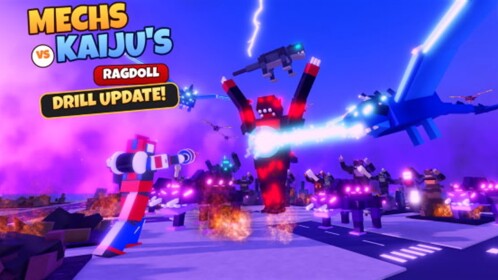
Mechs vs Kaiju's Ragdoll runs combat on real physics, so a hit lands with weight behind it rather than just subtracting a damage number: punched and kicked kaiju ragdoll-tumble and collapse, a grabbed kaiju can be lifted overhead, slammed into the ground or thrown, and a kaiju smashed through a building breaks the city apart. Your mech plays by the same rules - the developer describes it as a giant ragdoll mech.
- Combat uses six action buttons: GRAB, KICK, JUMP, ARM, L PUNCH and R PUNCH.
- A fly kick leaps your mech at a kaiju and sends it ragdoll-tumbling.
- On a downed kaiju, walk up and press KICK for a stomp - a gold critical number with the STOMPED OUT! banner.
- GRAB lifts a kaiju overhead: slam it into the ground for the BIG SLAM! bonus, or turn and throw it through a building.
- Dodging an attack triggers SLIPPED IT! - COUNTER NOW, and a tearing finisher shows RIPPED APART! Finisher +2 scrap.
What ragdoll physics actually change
The developer's description of the game is that you pilot a giant ragdoll mech and punch, grab, throw and smash kaiju through buildings with real physics - and the whole city breaks apart. That is what separates combat here from a standard brawler: attacks leave physical results on the street instead of only subtracting health. Kaiju are the clearest example. A fly kick sends one ragdoll-tumbling across the road, smashed and stomped bodies collapse ragdoll-style, and a defeated kaiju goes limp with blue fluid splatter around it - in one wave-clear moment the camera even sat inside the collapsed ragdoll body.
What each action does in practice
Combat runs on six on-screen action buttons - GRAB, KICK, JUMP, ARM, L PUNCH and R PUNCH (our controls guide covers them) - and the demonstrated physics moves look like this:
Combat actions and their physics results
- Action
- L PUNCH / R PUNCH
- What the physics does
- Alternating punch combos land on a kaiju with damage numbers popping on each hit.
- Action
- Fly kick
- What the physics does
- The mech leaps at a kaiju and the impact sends it ragdoll-tumbling.
- Action
- KICK on a downed kaiju
- What the physics does
- Walk up and press KICK for a stomp finisher - a gold critical number pops and STOMPED OUT! appears.
- Action
- GRAB
- What the physics does
- Lifts a kaiju overhead. Smashing it into the ground pays the BIG SLAM! bonus.
- Action
- Throw
- What the physics does
- Hurls the grabbed kaiju. A kaiju smashed through buildings takes the city apart with it.
- Action
- Dodge
- What the physics does
- Evading a kaiju attack flashes SLIPPED IT! - COUNTER NOW, your cue to hit back.
- Action
- Tear finisher
- What the physics does
- Tearing a kaiju's arm off shows RIPPED APART! and pays Finisher +2 scrap.
The on-screen banners double as a state reader. STOMPED OUT! confirms a stomp kill, BIG SLAM! confirms the ground slam connected, SLIPPED IT! - COUNTER NOW marks your counter window after a dodge, and RIPPED APART! Finisher +2 scrap tells you a tearing finisher just added scrap to your run (see how to get scrap).
Why grab-and-throw beats punch spam
Smashing kaiju through buildings is the developer-described core of the game, and a community getting-started guide builds its advice around it: prioritize grab → turn toward a building → throw instead of endless punch spam. The same guide tells players to watch their stamina bar, claiming an empty bar turns the ragdoll physics into free damage for the next kaiju. Both tips push toward the same conclusion - the throw is the move that uses the physics system at full scale. Our grab and throw page and stamina page cover both in more depth.
The city is built to break
Fights happen on city streets with the sea visible in the background - the direction the kaiju come from. Buildings are block-style props rather than fixed scenery: send a kaiju through them and the whole city breaks apart, which is exactly the payoff the throw-first habit above is aiming at. More on the collapsing arena is in our building destruction guide, and more on the monsters themselves is in the kaiju enemies page.
Reading the ragdoll states mid-fight
Because bodies behave physically, a wave keeps showing you states you can act on:
- A downed kaiju is a stomp opportunity: close the distance and press KICK for the gold-critical finisher.
- A kaiju you are carrying overhead can end as a BIG SLAM! ground impact or a throw into the nearest block.
- SLIPPED IT! - COUNTER NOW appears right after a successful dodge, marking the moment to counter.
- Blue fluid splatter and a collapsed ragdoll body mark a defeated kaiju.
- RIPPED APART! Finisher +2 scrap marks a tearing finisher and its scrap payout.
Mechs add their own physics moves
Every mech has its own weapons and moves tied to this physics combat. The official roster names, among others:
Named mechs and their physics moves
Cipsy Dagger
Chain sword finishers, a plasma beam and rocket elbows.
Coyote Tangle
Twin shoulder cannons, an EnergyCaster blast and a throwdown.
Black Alpha
Hydraulic fists, a piston grab and a hydraulic dropkick.
Red Tsunami
Saw claws, Thundercloud and a gut saw.
Bravo Guardian
A whip snare and an electric whip.
Beyond these, the roster also names Titan, Scorpion, Agility, Ripper, Mace and more. The mechs list covers the full roster, with dedicated pages such as Black Alpha and Red Tsunami.
The loop in one pass
Put together, the physics change is the game loop itself: hits tumble and collapse kaiju as well as damaging them, grabs turn enemies into objects you can slam or throw, and the city stands there to be knocked down with them. Learn to read the states - downed, grabbed, slipped, ripped - and each wave becomes a run of physics decisions rather than button mashing. For wave-to-wave advice beyond the physics, see our combat tips.